

Reflecting on Yesterday to Thrive Tomorrow
AI—large language models (LLMs) in particular—seems to be on everyone’s mind as we talk about how work is changing today and how it will change tomorrow. We’re seeing impressive advancements: editing our work, surfacing interesting ideas, and even generating full blog posts on newly launched websites (something I discovered recently when a new site came with three neatly written posts and no prompting whatsoever). While current and future use cases are often both under‑ and over‑estimated, one thing is clear: AI is already shaping how many of us work today and how even more of us will work in the future.
What’s often missing from these conversations, however, is yesterday. And yet, yesterday is just as critical to future success.
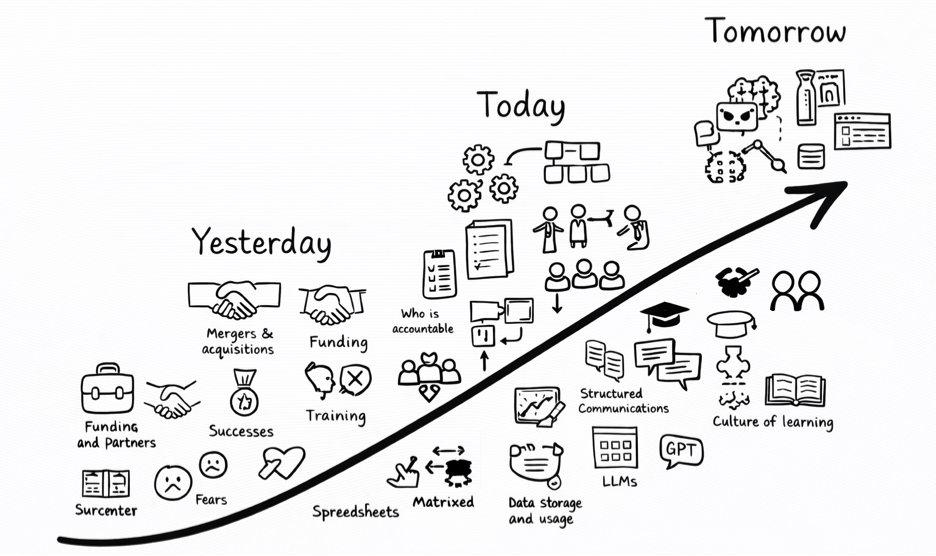
Yesterday is a foundational component of today’s—and tomorrow’s—companies. Major company events such as mergers and acquisitions, IPOs, or hitting financial goals shape not only the business itself but also the employee experience. Culture, training, and ways of working don’t appear overnight; they are built over time and continue to influence how work gets done every day.
When working with clients on major transformations or organizational design, I often start by asking a few core questions:
There is standard work that everyone must get done. At your company, what are the major functional groups?
Which leaders are part of the leadership team? Who is not included—and why?
How are you using your data today?
What have you done, or not done, when it comes to AI and LLMs?
What is holding you back the most?
When you think about the future, what is your ‘pie in the sky, unicorns sipping on rainbows’ ideal for your company in one or two years?
Once we understand where a company is today and where it wants to go, the past becomes a powerful place to explore next. Yesterday tells us where sensitivities exist, where issues tend to hide, and what a company may be ignoring until it can no longer afford to. This might show up as conflicting data—siloed across departments and used for different calculations even when measuring the same activity or metric.
At the same time, the past reveals what a company truly values. It highlights where teams thrive, such as organizations where a culture of learning is deeply ingrained. It can offer proven options when designing standardized frameworks and processes, and it can even strengthen employee loyalty by honoring what has worked well before.
Yesterday isn’t something to move past as quickly as possible. It’s an asset—one that provides context, insight, and direction. As AI continues to become more embedded in our daily lives and work, it becomes increasingly important not to forget about the valuable information, experience, and lessons stored in yesterday.
Because how we move forward is shaped, in no small part, by how well we understand where we’ve been.

Comments